Basic Concept
We are pursuing sustainable growth and medium- to long-term enhancement of corporate value under our group management philosophy of "For Confidence and Infinite Challenges."
We have adopted customer first, safety first, and social contribution as our action guidelines.
As part of management structure reform, we have also introduced a holding company structure to create an efficient management framework by separating management decision-making and supervisory functions from business execution functions.
We attach great importance to enhancing corporate governance, and have established a framework to earn the trust and appreciation of stakeholders to accelerate corporate growth and enhance corporate value.
For details, please refer to our "Approach to Each Principle of the Corporate Governance Code".
Approach to Each Principle of the Corporate Governance Code(Japanese Only)
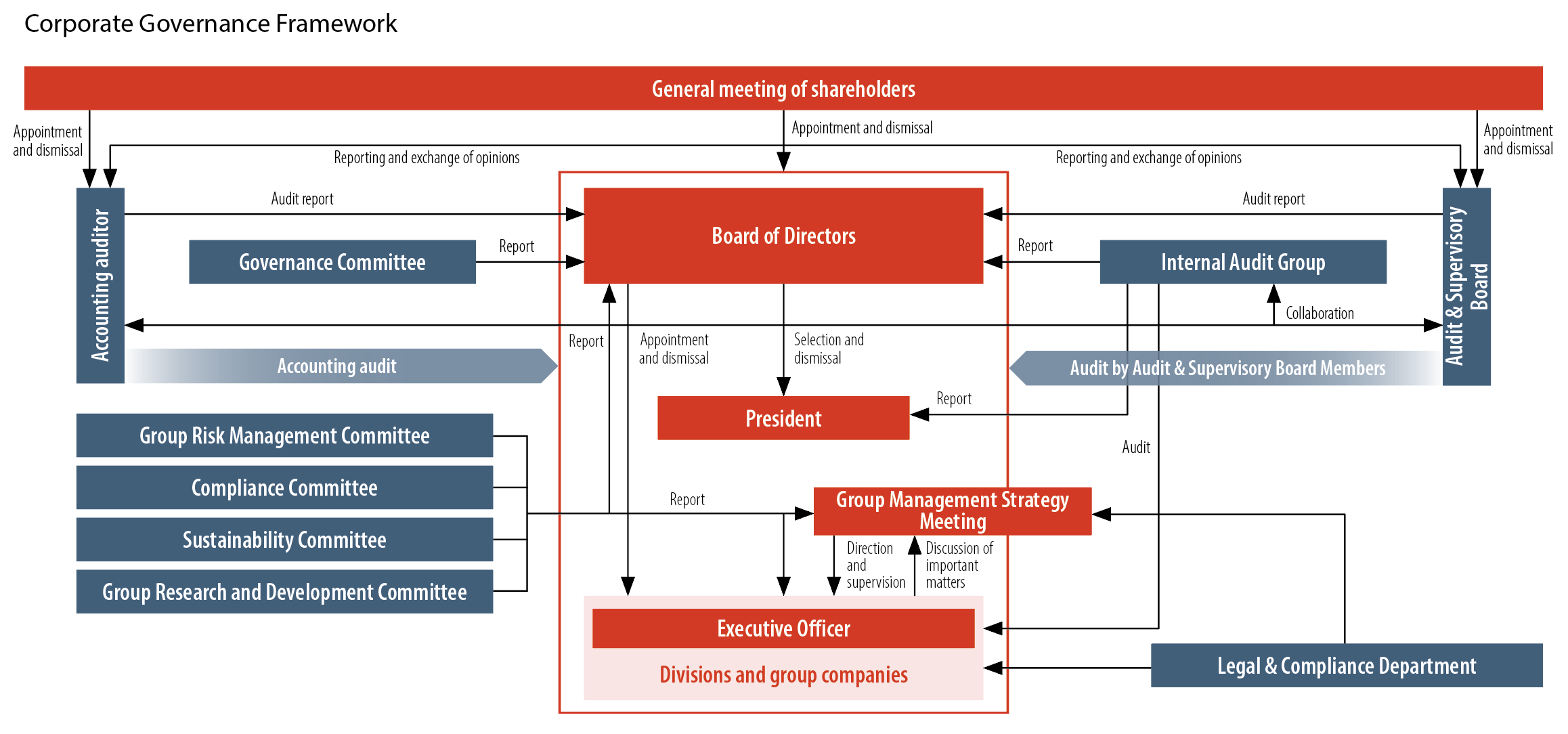
Corporate Governance Framework
Initiatives to Strengthen Corporate Governance
| May 2006 | Formulation of basic policies regarding internal control systems |
|---|---|
| June 2007 | Introduction of Executive Officer System |
| June 2012 | Abolition of retirement benefit plan for Directors/First appointment of outside directors |
| Oct. 2013 | Establishment of a pure holding company, Carlit Holdings Co., Ltd., through a single share transfer |
| Nov. 2015 | Introduction of the Board Benefit Trust (BBT) plan |
| June 2017 | Formulation of Corporate Governance Guidelines |
| Dec. 2018 | Establishment of Governance Committee |
| Mar. 2021 | Formulation of policy for determining the content of compensation, etc. for each individual director |
| May 2021 | Formulation of a skills matrix for Directors, Audit & Supervisory Board Members and Executive Officers |
| June 2021 | Partial revision of the Board Benefit Trust (BBT) plan |
| Apr. 2022 | Formulation of "Approach to Each Principle of the Corporate Governance Code" |
| July 2024 | Change of company name to Carlit Co., Ltd. |
| Oct. 2024 | Merger by absorption between Japan Carlit Co., Ltd. and Silicon Technology Corporation, transitioning from pure holding company to business holding company structure |
Management (Management Framework)
Based on decisions made by the Board of Directors, we have introduced a one-year term of office for Directors and an Executive Officer framework to facilitate the efficient execution of operations in response to rapid changes in the business environment.
In addition, four Audit & Supervisory Board Members, including three Outside Directors and two Outside Audit & Supervisory Board Members (one full-time Audit & Supervisory Board Member and one part-time Audit & Supervisory Board Member), supervise the execution of business by Directors, and we believe that the management supervision function is sufficient.
Outside Directors and Audit & Supervisory Board Members make useful recommendations from an independent and impartial standpoint, utilizing their extensive knowledge and experience in general management, laws and regulations, finance and corporate governance, etc.
In addition, each Audit & Supervisory Board member attends important meetings such as the Group Management Strategy Meeting to become familiar with our Group's business activities and enhance the effectiveness of management supervision.

Governance Committee
To ensure transparency and fairness in management, we have established the Governance Committee, the majority of whose members are Outside Directors, and serves as an advisory body to the Board of Directors.
The Committee deliberates on policies for the appointment and dismissal of senior management and Audit & Supervisory Board members, policies on the compensation structure and amount of compensation for directors, and matters related to corporate governance, and provides opinions and advice to the Board of Directors.
The composition of the Governance Committee is shown on the right.
| Chairperson | Outside Director | Yukari Murayama |
|---|---|---|
| Committee member | Outside Director | Yasuhiro Fujiwara |
| Committee member | Outside Director | Harutoshi Sato |
| Committee member | Representative Director and President & CEO | Hirofumi Kaneko |
Assessment of Effectiveness of Board of Directors
The Company conducts an annual self-assessment in the form of a questionnaire to ensure that the Board of Directors is appropriately fulfilling its roles and responsibilities and to ensure its effectiveness.
1) Evaluation and analysis methods
In March 2025, we conducted a survey among all Directors and Audit & Supervisory Board Members, asking closed and openended questions on the following. The Board of Directors evaluated these aggregate results at its April meeting and reviewed the current strengths and challenges of the Company's Board. The implementation and tabulation of the survey were outsourced to a third-party organization to ensure objectivity.
Survey items: 8 categories, 33 questions
- Roles and functions of the Board of Directors
- Composition and size of the Board of Directors
- Operation of the Board of Directors
- Cooperation with audit institutions
- Relationship with Outside Directors
- Relationship with shareholders and investors
- Operation of Governance Committee
- General overview
2) Evaluation
The Company's Board of Directors continues to assess that the effectiveness of the Board of Directors is largely ensured, as it was in the previous fiscal year. It was confirmed that the Governance Committee engages in thorough and active discussions on succession planning and director nomination and compensation. In addition, active meetings are held with shareholders and investors, with their feedback appropriately conveyed to the Board of Directors. However, we acknowledge that there are certain challenges pertaining to the administrative aspects of the Board of Directors, including the advance provision of materials essential for the Board of Directors' discussions. We will consider specific measures going forward.
3) Policy for addressing issues
Regarding the advance provision of materials required for Board of Directors' discussions, we will consider measures such as clarifying key points in currently used presentation materials and streamlining them into more focused and concise documents. After a thorough review of the effectiveness of the Board of Directors, we are committed to making further improvements in this area.
Examples of Key Discussions at the 2024 Board of Directors Meetings
Review of the previous Mid-Term Management Plan "Challenge 2024" and formulation of the new Mid-Term Management Plan
We conducted a review of the achievement status of the goals set in the previous Mid-Term Management Plan "Challenge 2024," which focused on the concept of strengthening our foundation. We engaged in extensive discussions to formulate the subsequent mid-term management plan, including topics such as the effectiveness of management based on the business portfolio, the outcomes of profit structure reviews, the status of foundation strengthening through investments in each business domain, and initiatives and challenges for new business and product development. This resulted in the development of the new Mid-Term Management Plan "Challenge 2027," which is focused on the concept of promoting investment.
Officer Compensation
Policy for determining the details of Officer compensation, etc.
The Company determines policies for determining the details of compensation for individual Directors through resolutions by the Board of Directors.
Before reaching these resolutions, the Board of Directors requests and receives advice from the Governance Committee.
Basic policy
Our basic policy for determining compensation for individual Directors is to set it at appropriate levels for their responsibilities under a system linked to shareholder interests so that the compensation serves as a sufficient incentive for the Directors to persistently strive to improve the corporate value.
Specifically, compensation for Directors with executive authority over operations comprises basic compensation, which serves as their fixed compensation, and bonuses, while Outside Directors, who are tasked with supervisory functions, are only paid the basic compensation in light of their duties.
Compensation structure

Type of compensation
Base compensation
As basic compensation, Company Directors are paid a fixed monthly amount determined based on many factors, including their position, responsibilities, what other companies are paying, Company performance, and Company employee wage levels as well as assessments of their duties.
Bonus(Performance-linked stock compensation plan "Board Benefit Trust (BBT)")
- The Company's performance-linked stock compensation plan aims to raise Directors' motivation to contribute to improving performance and increasing corporate value over the medium and long term by clarifying the link between Director compensation and Company performance and share price.
- The maximum total performance-linked stock compensation for a single fiscal year is ¥60 million.
- Directors (excluding Outside Directors) are awarded points corresponding to their level of achievement based on Company regulations for granting shares to Officers. Consolidated ordinary profit serves as the baseline for assessing their level of achievement.
Consolidated ordinary profit was selected as the baseline metric rather than operating profit, which reflects business activities and fluctuates in response to financing activities, because it expresses the overall profitability of management activities.
Directors are granted shares of the Company corresponding to the number of points awarded when they acquire rights to receive benefits under certain conditions. In principle, they receive the shares when they step down from their position as Directors.
The granted shares are acquired from the market or through disposal of the Company's treasury stock using money set in trust in advance
Performance-linked stock compensation plan "Board Benefit Trust (BBT)"
The number of points to be awarded is calculated using the following formula, and points are awarded to the scheduled recipients each year on the day on which the Annual General Meeting of Shareholders concludes.

Table 1︎ Funds for Distribution
*This table can be scrolled horizontally.
| Level of performance | Funds for distribution |
|---|---|
| Consolidated ordinary profit of ¥2,000 million or greater, and profit of ¥1,500 million or greater | 1.0% of consolidated ordinary profit (Maximum for Directors: ¥60 million) (Maximum for Executive Officers: ¥20 million) |
| Consolidated ordinary profit of less than ¥2,000 million, or profit of less than ¥1,500 million when ordinary profit is ¥2,000 million or greater | No payments |
- 1 Consolidated ordinary profit and funds for distribution are rounded down to the nearest million yen.
- 2 If suitable reasons exist, the Board of Directors may pass a resolution to award no points.
Table 2. Point Percentages
| Position | Point percentage |
|---|---|
| Chair of the Board of Directors | 2.5 |
| President | 4.0 |
| Vice President | 2.5 |
| Position | Point percentage |
|---|---|
| Senior Managing Director | 2.0 |
| Managing Director | 1.5 |
| Director | 1.0 |
- 1 A maximum total of 120,000 points can be awarded to Directors in a single fiscal year.
- 2 Monetary amounts allocated according to point percentages are rounded down to the nearest ¥10,000.